ADA Ramp Requirements, Specs & Slope Guidelines (2026 Update)
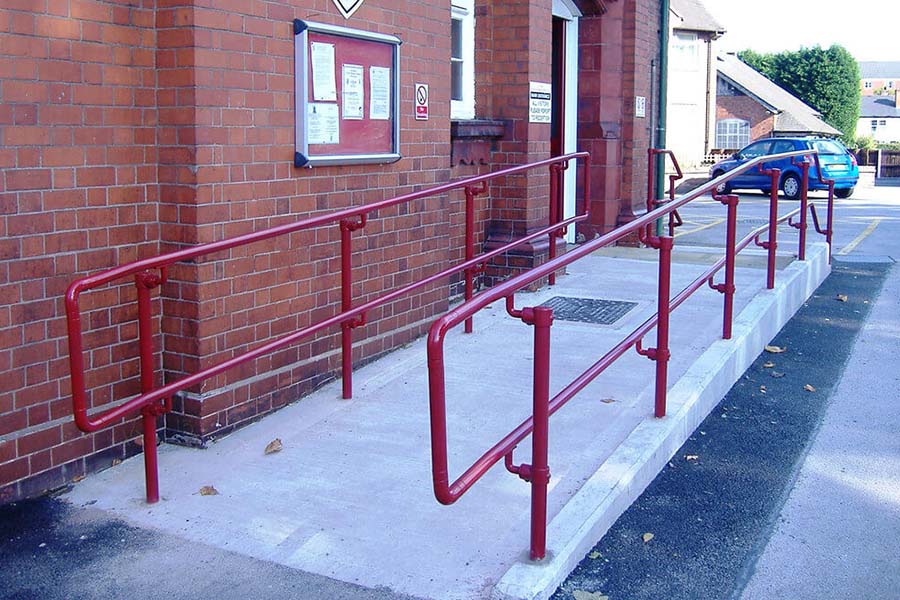
Knowing what the ADA code requires from you can be disheartening if you don’t know where to look. It’s also altogether possible for you to miss an important detail and build your ramp in a way that doesn’t comply with the standard.
In this article, we’ll review the various requirements for ADA handrails and when designing a wheelchair ramp.
ADA Ramp Slope & Rise Requirements
The minimum slope for a surface to be considered a ramp is 1:20 (for every 20 inches in length, it rises 1 inch). Anything less than that is considered a standard walking surface.
The maximum slope for a ramp to be compliant with ADA is 1:12. There are some exceptions to this rule, and they all apply to existing buildings. There is some grace for locations that have already been built and there are space limitations that prevent standard compliance.
You can have a slope that is no steeper than 1:10 if the total rise of the ramp is 6 inches or less. If the slope is 1:8, then make sure that the total rise of the ramp is no more than 3 inches. Remember, this only applies to existing sites with space limitations. If this is a new build or you have enough space, then plan for a 1:12 or less ramp to be compliant.
The cross slope of a ramp is the slope that runs perpendicular to the direction of travel. This should not be greater than 1:48.
Surface & Width Specifications
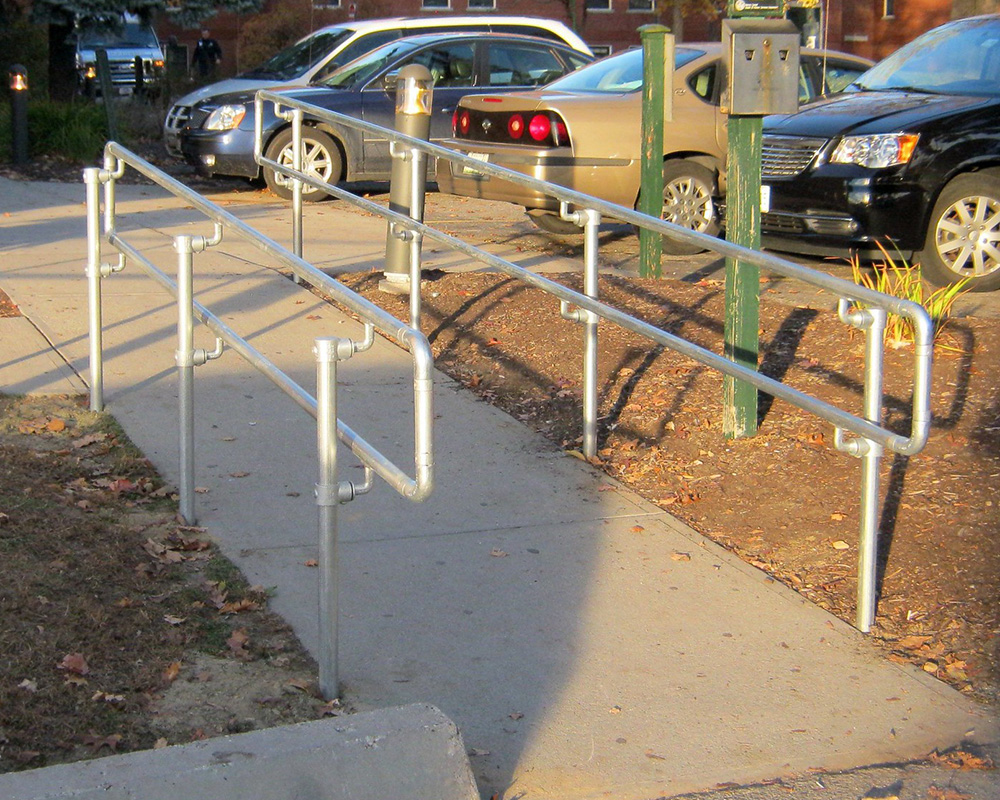
It’s important to make sure that the slope is the only level change across the surface of the ramp. Ramps need to be stable, firm, and slip-resistant.
A stable surface isn’t changed when contaminants or force are applied. A firm surface resists deformation and indentation. A slip-resistant surface provides enough friction to allow for safe travel across the surface.
Any openings in the surface should not be able to have a ½ inch sphere pass through them. If they are elongated, then the long dimension should be perpendicular to the direction of travel.
Ramp surfaces should have 36 inches of clear width. So, make sure that you consider this when installing handrail as that clear width should be in between the handrails.
Landing and Platform Requirements
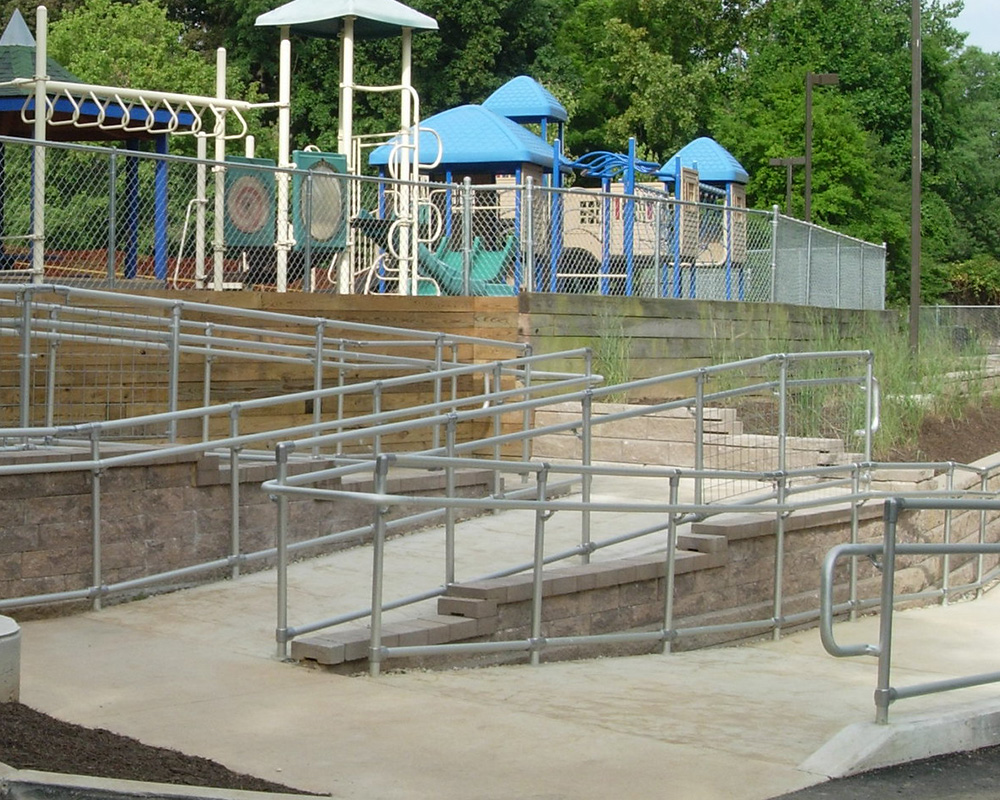
There should be a landing at the top and bottom of every ramp. A single ramp should not have a rise greater than 30 inches. This means that you will need to provide a landing for every 30 inches in rise for your ramp as well.
Landings should have a clear width as wide as the widest ramp that leads to the landing. The clear length of a landing should be 60 inches. If you change direction, then the landing needs to have a clear length and width that is at least 60 inches by 60 inches.
Lastly, if the landing is subject to wet conditions, then design the landing so that it doesn’t accumulate water.
Handrail & Edge-Protection Rules
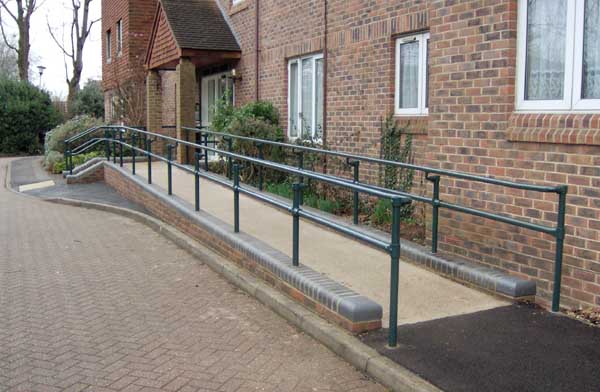
You need to have edge protection on each side of the ramp. If the ramp rises more than 6 inches, then handrails should also be installed.
The purpose of this protection is to prevent a wheelchair or crutch tip from slipping off the edge of the ramp. There are two ways that you do this.
ADA Handrails should be 12 inches from the edge of the ramp (don’t forget to keep the 36-inch clear width). The 12 inches are measured from the edge of the ramp to the inside of the handrail.
A curb or barrier of some kind should be built so that a sphere of 4 inches cannot pass by the railing anywhere within 4 inches of the ramp. Often, this is accomplished by using a bottom rail on the existing handrail.
ADA Specs for Ramp Materials & Strength Requirements
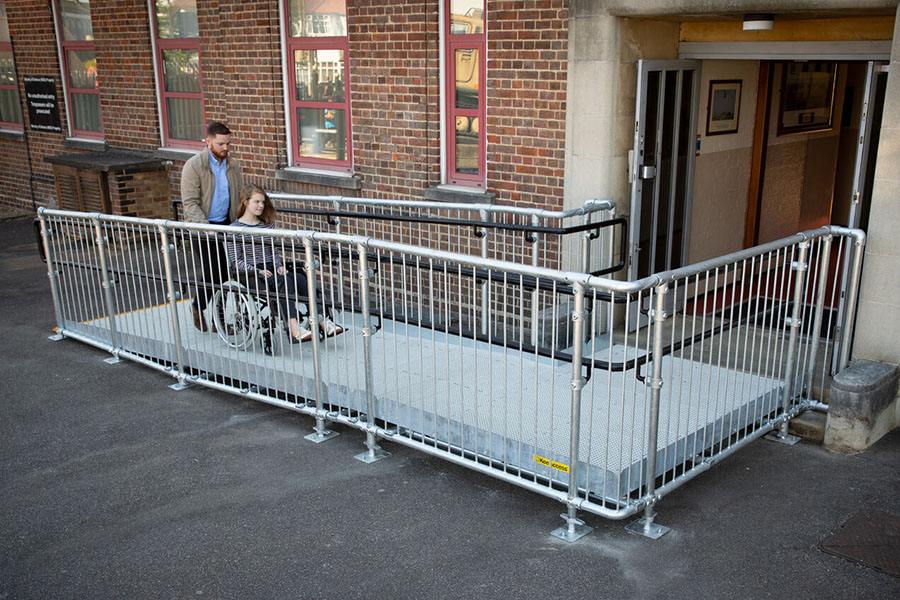
Allowed Ramp Materials
The ADA does not mandate specific materials, but whatever is used must meet performance requirements. Common compliant materials include:
- Aluminum (lightweight, corrosion-resistant, popular for modular ramps)
- Steel (strong and durable; typically galvanized or powder-coated to prevent rust)
- Concrete (extremely durable and permanent)
- Wood (allowed only if structurally sound, properly treated for weather, and non-slip)
- Composite materials (high traction and resistant to weathering)
Key requirement:
All ramp surfaces must be firm, stable, and slip-resistant, regardless of the material used.
Structural Strength Requirements for Ramps
While ADA gives performance outcomes rather than detailed engineering specs, the ramp must:
- Support at least 300 lbs. concentrated load at any point (industry standard used for wheelchair ramps).
- Withstand a live load of 100 pounds per square foot (psf), a typical engineering requirement referenced by many codes covering ADA installations.
- Resist deformation and maintain a stable surface under repeated use.
Local building codes often provide the structural load requirements that complement ADA; ADA’s focus is on safety, usability, and accessibility.
Handrail Material Requirements
Handrails can be made from:
- Metal (aluminum, steel, stainless steel; most common)
- Wood (smooth, splinter-free, properly finished)
- PVC/composite materials
- Other rigid, durable materials capable of withstanding force without excessive deflection
Handrail surfaces must be:
- Smooth and continuous
- Free of sharp edges
- Able to be grasped easily (ADA handrail graspability rules still apply)
Addtional ADA Ramp Compliance Questions

Do I need a handrail on both sides of my ramp?
Yes, to be ADA-compliant, you must have railings on both sides of your ramp, and those handrails must adhere to all ADA handrail requirements.
If I run a business out of my house, do I need a permit to build an access ramp?
Yes. Whether it is your home, business, or business run from your home, you must have a permit from your city or town to build an access ramp. Double-check with your local municipality to see which permits you need to obtain.
Is there a maximum distance between handrails on ramps for ADA compliance?
No, there is no requirement for a maximum distance between handrails.
Do I need a mid-rail on my ramp railing?
Depending on where the ramp railing is installed, you may need a mid-rail. If the railing will be installed where children will be using the ramp for access, like at a school or library, then you do need a mid-rail. Otherwise, it is not required.
What materials can be used for an ADA-compliant ramp surface?
The surface of your ramp must be firm, stable, and slip-resistant. The common materials are concrete, asphalt, wood, or metal with a non-slip finish.
Are portable ramps ADA-compliant?
Only if they meet all the requirements including slope, width, surface texture, and handrails.
Are stairs required if a building has an ADA ramp?
No, but stairs are often provided alongside ramps for those who prefer to use them.
Do doorways at the top or bottom of an ADA ramp need to be automatic?
No, but doors must still comply with ADA accessibility guidelines.
Can both handrails be mounted directly on the wall?
Yes, so long as they provide 1.5 inches of clearance from the wall for easy gripping.
How much weight must a ramp railing be able to support?
Handrails must be able to withstand a force of 200 lbs. in the outward and downward direction.
ADA Ramp Solutions

So, what if you don't want or have the ability to build your own ADA compliant ramp?
Well, we have the all-in-one solution for you here. Rightway Pro is a modular ramp system that is engineered and designed to be ADA compliant right out of the box.




Whether it's for your commercial building or a modular building, Rightway Pro can be easily installed and moved with no skilled labor and basic tools. Contact our project specialists to see if Rightway Pro is the solution for you.
ADA Compliance Next Steps
Now that you understand how your accessibility ramp needs to be built, it’s important to understand how ADA wants you to build the handrails we just mentioned. Check out the ADA Handrails Guide to learn what you need to do to continue providing a safe place for people to access.
These requirements are based on Federal ADA Codes 405 Ramps and 302 Floor or Ground Surfaces. Make sure to review your local codes as they may differ from federal requirements.